Haylo

Energy

An AI-powered smart home solution that learns and adapts to you and your home in real time.

Haylo

Energy

An AI-powered smart home solution that learns and adapts to you and your home in real time.

Haylo

Energy

An AI-powered smart home solution that learns and adapts to you and your home in real time.

Main Image

Case Study

Effortless energy management that puts the power in your hands

YEAR

2023

Services

Product Design

Agency

with Haylo Ventures

YEAR

2023

Services

Product Design

Agency

with Haylo Ventures

In 2022, home energy was top of mind for everyone, utility bills were skyrocketing and saving energy had become a necessity for both financial and environmental reasons. At the same time, interest in smart home technology was surging, the global smart home market was projected to grow over 600% in the next decade. Yet despite a proliferation of “smart” thermostats, most households still lacked real insight or control over their heating.

Haylo emerged as an early-stage startup determined to change this by bringing a new level of intelligence to home heating, inspired by a simple idea of putting the power in the homeowner’s hands. The vision was to make it effortless for anyone to save energy and money by showing them exactly where their energy goes and using AI to help them prevent waste.


Making Energy Saving Effortless

As the Founding Product Designer, I helped define a few key product design goals. From the start we agreed that Haylo’s success would hinge on clarity, simplicity, and user trust, with our goals including:

  • Easily accessible: Design the experience so that anyone could use Haylo without confusion. Advanced AI technology would be hidden behind a simple, friendly interface, so that an average homeowner (not just tech enthusiasts) could grasp it.

  • Both automated and actionable: Translate complex energy data into actionable insights for users, and considerately balance meaningful suggestions with AI automation, to make energy saving effortless without taking away users' autonomy.

  • A service, not a gadget: Differentiate from other smart thermostats by removing the usual techy complexities and turning the focus to outcomes. Many existing solutions saved little and demanded too much from users, Haylo’s needed to do the day-to-day heavy lifting in the background, showing increased value over time.

  • Build Trust: Earn users’ trust and make them feel good about using the product by being transparent about results and changes, in a confident yet considerate way. 

These goals shaped every design decision, from the tone of our copy to the layout of the app. 

WATCH THE VIDEO

Designing Smart Without the Complexity

Designing Haylo meant balancing cutting-edge tech with real human needs. My approach was highly user-centered and iterative, working closely with the wider team to align what could be built with what people actually needed, with each decision made in alignment with the goals.

Navigation

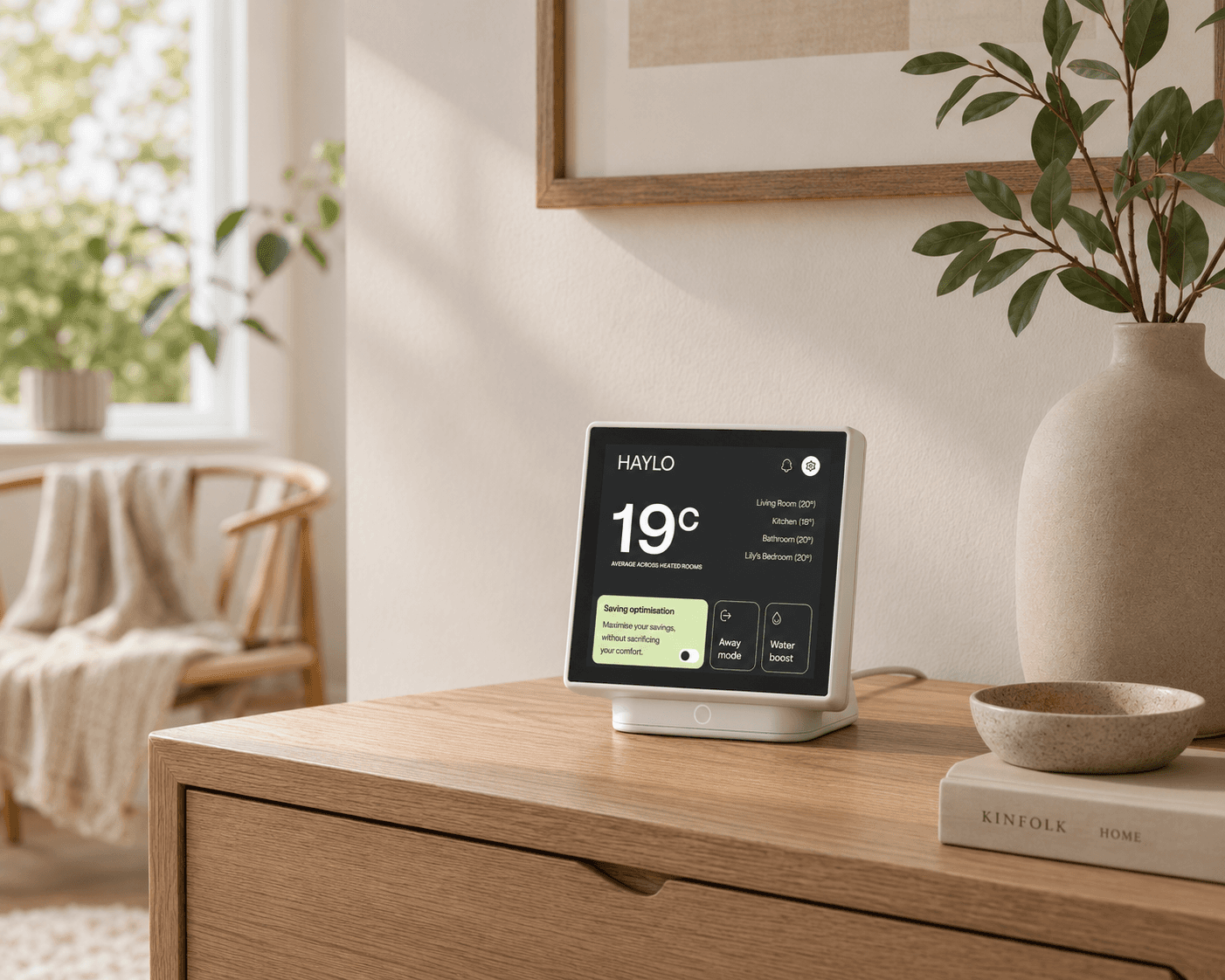
Rather than burying features in menus I put the essentials front and center, using a simple navigation made up of a few primary tabs to ensure that users never felt lost. The home screen became a dashboard showing the most important things at a glance, for instance which rooms are being heated right now and how much it’s costing. This clear structure meant that from day one, users would know exactly how to check their home’s status or adjust the temperature in any room without digging through menus.

Navigation

Rather than burying features in menus I put the essentials front and center, using a simple navigation made up of a few primary tabs to ensure that users never felt lost. The home screen became a dashboard showing the most important things at a glance, for instance which rooms are being heated right now and how much it’s costing. This clear structure meant that from day one, users would know exactly how to check their home’s status or adjust the temperature in any room without digging through menus.

Navigation

Rather than burying features in menus I put the essentials front and center, using a simple navigation made up of a few primary tabs to ensure that users never felt lost. The home screen became a dashboard showing the most important things at a glance, for instance which rooms are being heated right now and how much it’s costing. This clear structure meant that from day one, users would know exactly how to check their home’s status or adjust the temperature in any room without digging through menus.

Onboarding

Setting up smart home devices can be intimidating, and Haylo didn’t want to start off on the wrong foot, so I designed an onboarding flow that was friendly and frictionless. The app walked users through linking their Haylo sensors and thermostats step by step in plain language (no technical jargon), including videos and hints to reassure users along the way. My mantra was “don’t assume knowledge”, every term was explained in simple terms, and every step was bite-sized. As a result, new users could get Haylo up and running quickly and confidently, without feeling overwhelmed by the tech.

Onboarding

Setting up smart home devices can be intimidating, and Haylo didn’t want to start off on the wrong foot, so I designed an onboarding flow that was friendly and frictionless. The app walked users through linking their Haylo sensors and thermostats step by step in plain language (no technical jargon), including videos and hints to reassure users along the way. My mantra was “don’t assume knowledge”, every term was explained in simple terms, and every step was bite-sized. As a result, new users could get Haylo up and running quickly and confidently, without feeling overwhelmed by the tech.

Onboarding

Setting up smart home devices can be intimidating, and Haylo didn’t want to start off on the wrong foot, so I designed an onboarding flow that was friendly and frictionless. The app walked users through linking their Haylo sensors and thermostats step by step in plain language (no technical jargon), including videos and hints to reassure users along the way. My mantra was “don’t assume knowledge”, every term was explained in simple terms, and every step was bite-sized. As a result, new users could get Haylo up and running quickly and confidently, without feeling overwhelmed by the tech.

Presenting Data

One of the hardest design tasks was turning raw energy data into something anyone could understand and act on. I approached this by using intelligent data visualizations and conversational content. Instead of dumping numbers and graphs, the app provided clear narratives: “Heating your living room cost £1.20 today.” I used comparisons to make data relatable: for instance, if Haylo saved a user 10 kWh in a week, we might equate that to “enough energy to brew 50 cups of tea.” By keeping metrics tied to everyday life, we made the abstract concept of energy tangible. As the AI learnt, the insights screen started to highlight trends and actions, for example: “Mondays use 20% more heating than Sundays”. Every insight was coupled with an action, or highlighted an automatic adjustment, ensuring the insight was actionable and left the user feeling empowered.

Presenting Data

One of the hardest design tasks was turning raw energy data into something anyone could understand and act on. I approached this by using intelligent data visualizations and conversational content. Instead of dumping numbers and graphs, the app provided clear narratives: “Heating your living room cost £1.20 today.” I used comparisons to make data relatable: for instance, if Haylo saved a user 10 kWh in a week, we might equate that to “enough energy to brew 50 cups of tea.” By keeping metrics tied to everyday life, we made the abstract concept of energy tangible. As the AI learnt, the insights screen started to highlight trends and actions, for example: “Mondays use 20% more heating than Sundays”. Every insight was coupled with an action, or highlighted an automatic adjustment, ensuring the insight was actionable and left the user feeling empowered.

Presenting Data

One of the hardest design tasks was turning raw energy data into something anyone could understand and act on. I approached this by using intelligent data visualizations and conversational content. Instead of dumping numbers and graphs, the app provided clear narratives: “Heating your living room cost £1.20 today.” I used comparisons to make data relatable: for instance, if Haylo saved a user 10 kWh in a week, we might equate that to “enough energy to brew 50 cups of tea.” By keeping metrics tied to everyday life, we made the abstract concept of energy tangible. As the AI learnt, the insights screen started to highlight trends and actions, for example: “Mondays use 20% more heating than Sundays”. Every insight was coupled with an action, or highlighted an automatic adjustment, ensuring the insight was actionable and left the user feeling empowered.

Integrating AI

The real magic of Haylo lied in its AI-powered automation and suggestions. I worked closely with our engineering and data science team to integrate Haylo’s self-learning algorithms into the UX. We essentially taught Haylo to adapt to the user’s lifestyle: using sensors for presence detection, checking weather forecasts, learning usage patterns, all to optimize the heating schedule in real time. From a design perspective, our challenge was to make this intelligence feel reassuring and not intrusive. I created an experience that would gently prompt the user with suggestions in a supportive and non-judgemental tone: “Haylo can turn off the guest room radiator to save £2 today”. The end result was a smooth partnership between human and AI in which users could trust Haylo to highlight the routine saving while they remained the ultimate decision makers.

Integrating AI

The real magic of Haylo lied in its AI-powered automation and suggestions. I worked closely with our engineering and data science team to integrate Haylo’s self-learning algorithms into the UX. We essentially taught Haylo to adapt to the user’s lifestyle: using sensors for presence detection, checking weather forecasts, learning usage patterns, all to optimize the heating schedule in real time. From a design perspective, our challenge was to make this intelligence feel reassuring and not intrusive. I created an experience that would gently prompt the user with suggestions in a supportive and non-judgemental tone: “Haylo can turn off the guest room radiator to save £2 today”. The end result was a smooth partnership between human and AI in which users could trust Haylo to highlight the routine saving while they remained the ultimate decision makers.

Integrating AI

The real magic of Haylo lied in its AI-powered automation and suggestions. I worked closely with our engineering and data science team to integrate Haylo’s self-learning algorithms into the UX. We essentially taught Haylo to adapt to the user’s lifestyle: using sensors for presence detection, checking weather forecasts, learning usage patterns, all to optimize the heating schedule in real time. From a design perspective, our challenge was to make this intelligence feel reassuring and not intrusive. I created an experience that would gently prompt the user with suggestions in a supportive and non-judgemental tone: “Haylo can turn off the guest room radiator to save £2 today”. The end result was a smooth partnership between human and AI in which users could trust Haylo to highlight the routine saving while they remained the ultimate decision makers.

Delivering on the Promise of Smart Simplicity

The outcome was a system that took the complexity out of home energy management. From the moment you opened the app it offered a clear, reassuring view of how your home was performing and how it could be improved. At its core was a real sense of intelligence working quietly in the background, the app sympathetically made decisions automatically, and provided helpful nudges where more appropriate. Rather than just presenting the user with raw data, Haylo used plain, human language to explain what was happening and why, building trust through transparency and making the user feel like they were still in control.

A Smart Solution, Even Without Market Launch

While the Haylo product ultimately did not reach a public launch due to funding challenges, the outcomes of the design work were incredibly positive in many ways. Internally, our prototype and beta received enthusiastic praise from stakeholders, the founders and team were thrilled to see the vision come to life so clearly. More importantly, in focus group tests, homeowners responded with intrigue and excitement for potential savings, the participants consistently reported that Haylo’s was easy to use and understand, even for those with no smart home experience. This feedback was strong validation that we had achieved our core goal of making energy tech approachable and effective.